


Cat Ba langur (Trachypithecus poliocephalus) is a rare primate species endemic to Vietnam belonging to the genus Trachypithecus (Crested Langurs or Limestone Langurs).
Other names:
- English: Cat Ba hooded black leaf monkey, golden-headed langur, and Tonkin hooded black langur.
- Vietnamese: Voọc Cát Bà, Voọc đầu trắng, Voọc đen đầu vàng, Voọc đầu vàng.
APPEARANCE
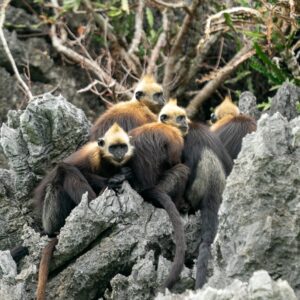
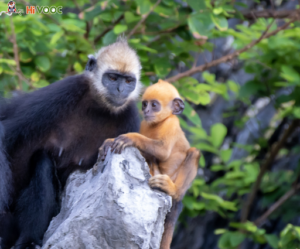
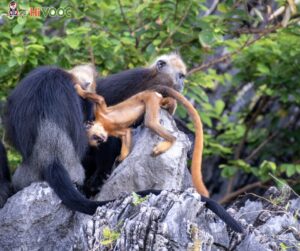
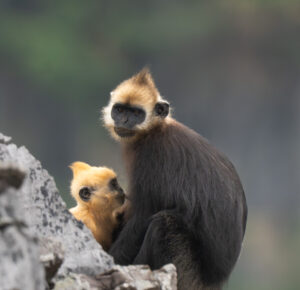
Cat Ba langurs are covered in darkish brown to black pelage. Their faces are dark and surrounded by pale tan and golden orange hairs, which grow upwards, forming a crest on the langur’s head. The infants have a vibrantly golden orange fur, making them pronounced in contrast to their adults’ blackish bodies. This is thought to promote alloparenting, a form of care made by adults within a group other than biological parents. The bright orange outlook enables adults to supervise the infant properly during movement or resting. The fur will then convert into black when they are about a year and a half old. This unique characteristic has been applied as an aging method to estimate the age of the langur individuals from a newborn to a fully-developed adult [4].
Cat Ba langurs also have a remarkably long tail that can reach up to 70 cm. However, like those of other langurs, the tail is not prehensile, meaning that it cannot be utilized for grasping objects.
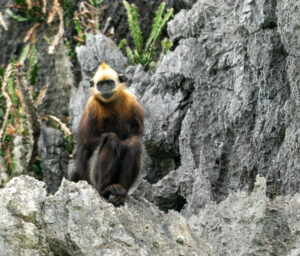
Cat Ba langurs have five-digit hands and feet, making them highly dexterous when moving in tough areas like the cliffs of the island. The head-to-body length ranges from 50–60 cm in females and 55–65 cm in males. Their average weight is around 6–9.5 kg, and the tail length ranges from 78–90 cm [5]. Both sexes are covered in thick black pelage and a golden orange on the head; however, females have light-colored patches in the pubic area, which is the primary visual cue for sex identification [4].
GEOGRAPHIC DISTRIBUTION AND HABITAT
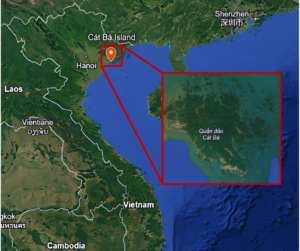
Endemic to Vietnam, Cat Ba langurs are exclusively distributed in Cat Ba Island, one of Cat Ba Archipelago’s 366 islands, in northern Vietnam, where they inhabit limestone karst forests. They are restricted to an area of 22 km square of the island, making them vulnerable to unsustainable tourism and other human activities such as illegal hunting.

DIET
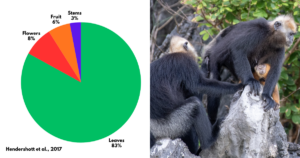
Cat Ba langurs are folivorous, so they feed on primarily leaves, and occasionally fruits, and flowers. Studies found out that over 80% of Cat Ba langur’s diet is leaves, followed by flowers (8%), fruits (6%), and tree bark (3%) [2].
Because of habitat surrounded by sea, Cat Ba langurs have also evolved to adapt to the surrounding environment by the capability to drink salt water, a unique trait that helps distinguish Cat Ba langurs from other langurs [1][7].
BEHAVIOR AND LIFESTYLE
Cat Ba langurs are diurnal species, that means they spend the majority of their time during daytime and sleep at night on ledges and in caves. They are also semi-arboreal as they can be either on the ground or trees.
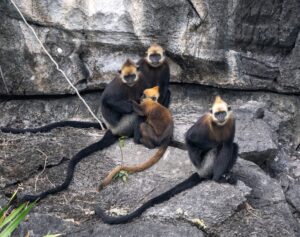
The langurs live in small social groups of six individuals. Groups are mostly composed of a male with multiple females, yet there are also some recorded same-sex groups and bachelor individuals.
Regarding communication, Cat Ba langurs communicate through vocalizations along with other forms of communication, such as body posturing and facial expressions. This species also gets involved in allogrooming, or the grooming of each other, to solidify bonding with members in a group [5].
REPRODUCTION AND FAMILY
The gestation period is about 200 days; the expecting female typically births a single offspring. The infant was brought up by the mother accompanying females in a group, a behavior known as allomothering/alloparenting as mentioned earlier.
ECOLOGICAL ROLE
Being secluded from the mainland, Cat Ba langurs have no predators hunting them. This species is believed to play a pivotal role as seed disperser as they distribute undigested seeds from fruits that are excreted with their droppings, thereby facilitating the growth of vegetation in the island.
CONSERVATION STATUS
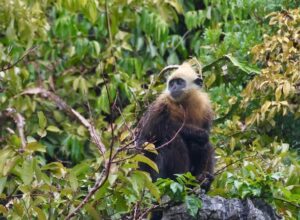
Currently, Cat Ba langurs are listed as Critically Endangered (IUCN Red List). The Cat Ba Langur is listed in Appendix I of CITES, Decree No. 64/2019/ND-CP, and Group IB of Decree No. 84/2021/ND-CP issued by the Government [6].
With fewer than 80 individuals remaining in the wild, Cat Ba langurs are considered as one of the rarest primates in the world. They are grappling with a majority of threats entailing deforestation, unsustainable tourism, hunting for meat and medicinal purposes, habitat loss and habitat fragmentation [1][2].
Also, because the numbers of Cat Ba langurs has declined to an estimated low of 80, they may face inbreeding depression due to few individuals, which ultimately leads to decreased genetic diversity, making them susceptible to diseases and fitness, highlighting the ever growing importance to conserve such a majestic species.
CONSERVATION EFFORTS
To protect Cat Ba langur from the brink of extinction, Cat Ba Langur Conservation Project (CBLCP), administered by the Münster Zoo and Zoo Leipzig in Germany, was founded in November 2000 [3][5][7]. The project focuses on protection, research, and education to conserve Cat Ba langurs as well as other species in order to preserve the biodiversity of Cat Ba archipelago. In addition, strict law enforcement against poaching and habitat destruction must be reinforced and relocation of individuals among subpopulations can be done so that genetic diversity is able to increase, ensuring the existence of Cat Ba langurs in the future.
REFERENCES
1. Cat Ba Langur. Endangered Primate Rescue Center.
2. Hendershott, Rebecca & Behie, Alison & Rawson, Benjamin. (2017). Seasonal Variation in the Activity and Dietary Budgets of Cat Ba Langurs (Trachypithecus poliocephalus). International Journal of Primatology. 37. 10.1007/s10764-016-9923-z.
3. iNaturalist. (n.d.). Trachypithecus poliocephalus.
4. Nadler T. (2020). The development of pelage coloration in Cat Ba langurs (Trachypithecus poliocephalus). Vietnamese Journal of Primatology, 3(2): 23-37.
5. New England Primate Conservancy. (n.d.). Cat Ba Langur, Trachypithecus poliocephalus. Retrieved March 26, 2026, from https://neprimateconservancy.org/cat-ba-langur/
6. Nguyễn Đình Duy, Trịnh Đình Hoàng, Nguyễn Vĩnh Thanh, Hà Thăng Long, 2023. Trachypithecus poliocephalus. Danh lục Đỏ Việt Nam. MM21
7. John R. Platt. (2015, August 31). The Cat Ba langur: A primate walks the razor’s edge of extinction. Mongabay. https://news.mongabay.com/2015/08/the-cat-ba-langur-a-primate-walks-the-razors-edge-of-extinction/
LE QUANG