


HANDCRAFTED EXPERIENTIAL
Travel with us to create magical memories and support willdife conservation projects together
Tam Mỹ Tây
Start Free Planning with HIVOOC
Tam Mỹ Tây Forest is located in Tam Mỹ Tây Commune, Núi Thành District, Quảng Nam Province, in central Viet Nam. Despite being relatively small in size, this forest is globally significant as it serves as one of the few remaining strongholds of the grey-shanked douc langur (Pygathrix cinerea), one of the world’s most endangered primates. Over the past decades, conservation efforts in the area have gained momentum, leading to increased awareness and protection of its unique biodiversity.
Landscape and Ecosystem
Unlike vast national parks such as Cúc Phương or Phong Nha-Kẻ Bàng, Tam Mỹ Tây Forest consists of a patchwork of natural forests and plantations, spread across four main mountain tops. These mountains, ranging from 100 to 600 meters apart, create fragmented habitats for wildlife. The total forested area covers around 30 hectares, making it a relatively small but crucial habitat for the endangered species residing within.
The forest features tropical evergreen vegetation, but in recent years, acacia and oil palm plantations have expanded, gradually replacing natural habitats. Seasonal variations influence the forest’s climate, with periods of high humidity creating ideal conditions for a diverse range of flora and fauna.
Wildlife and Biodiversity
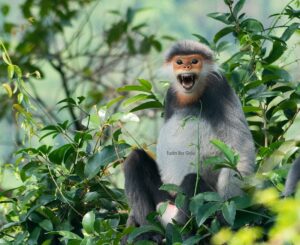
The grey-shanked douc langur is the most iconic species found in Tam Mỹ Tây. This species, endemic to central Vietnam, is listed as Critically Endangered by the IUCN. Once thought to be on the brink of extinction, recent conservation efforts have helped the local langur population grow from 50 individuals in 2019 to around 69 today.
Aside from langurs, the forest also supports various species of:
- Birds, including hornbills and kingfishers
- Small mammals, such as civets and squirrels
- Reptiles and amphibians, thriving in the humid microhabitats
- Native flora, which includes tall hardwood trees, lianas, and undergrowth plants
Despite its relatively small size, Tam Mỹ Tây Forest plays an important role in maintaining local biodiversity and ecological balance.
Conservation Challenges and Threats
Despite the successes in protecting the grey-shanked douc langur, Tam Mỹ Tây still faces multiple threats:
- Habitat Fragmentation: The increasing expansion of acacia plantations reduces the connectivity between forested areas, forcing langurs to cross open ground, exposing them to risks.
- Hunting and Poaching: Though greatly reduced, illegal poaching for bushmeat and the wildlife trade remains a concern in remote areas.
- Deforestation and Land Conversion: The growth of commercial plantations and human settlements continues to shrink the remaining natural habitat.
- Climate Change: Unpredictable weather patterns could impact the delicate balance of the forest ecosystem, affecting food availability and water sources for wildlife.
Conservation Efforts and Community Involvement
In response to the threats facing the grey-shanked douc langur, multiple conservation initiatives have been implemented:
- Community-Based Conservation Patrols: Local villagers have formed volunteer patrol teams to monitor and protect langur populations. These patrols document sightings, prevent illegal hunting, and report threats to authorities.
- Public Awareness and Education: Conservation organizations, such as WWF-Vietnam and GreenViet Biodiversity Conservation Center, have conducted educational programs in schools and communities to promote sustainable land use and discourage poaching.
- Reforestation and Habitat Restoration: Efforts are underway to restore native forests by reducing acacia plantations and reintroducing indigenous plant species that provide natural food sources for langurs.
- Sustainable Ecotourism Initiatives: Though still in its early stages, small-scale ecotourism projects are being considered to create financial incentives for local communities while minimizing human disturbance to the langurs’ habitat.
Future Prospects and Long-Term Goals
The success of Tam Mỹ Tây’s conservation work has gained international recognition, particularly through documentaries such as Tam My Tay, which showcases the community’s dedication to protecting its unique primates. However, continuous support and sustainable land management policies are essential to securing the future of this fragile ecosystem.
Key priorities moving forward include:
- Expanding protected areas to prevent further habitat loss
- Strengthening wildlife monitoring programs to track langur populations
- Encouraging alternative livelihoods for locals, reducing dependency on land conversion for agriculture
- Increasing government and international funding to scale up conservation efforts
While Tam Mỹ Tây may not be the largest forest in Vietnam, it stands as a testament to the power of community-driven conservation. The survival of the grey-shanked douc langur depends on continued efforts to protect this last refuge—ensuring that future generations will still have the opportunity to witness one of Vietnam’s rarest and most beautiful primates in the wild.

