


The Malayan tapir is often mistaken for either a pig or a baby elephant with a short trunk. In reality, it is an animal known as the “gentle gardener of the forest.” Once recorded in Vietnam, but today the Malayan tapir is considered extinct in the country.
APPEARANCE
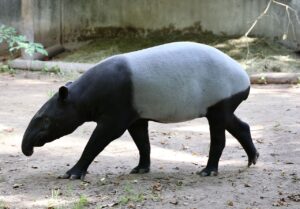
The Malayan tapir (Tapirus indicus) is an odd-toed ungulate in the family Tapiridae, order Perissodactyla — the same order that includes horses (Equidae) and rhinoceroses (Rhinocerotidae). Tapirs are among the world’s most primitive mammals, with external features that have remained largely unchanged for over 20 million years [1]. The Malayan tapir is the largest of the four tapir species and the only member of the Old World tapir. Adults stand about 90–110 cm tall, weigh between 250–320 kg, and measure 1.8–2.5 meters in length. Their lifespan is approximately 30 years. The name “Tapir” comes from a Brazilian Indian word meaning “thick”, indicating the thick hide of the animal. In Thai, tapirs are coined “สมเสร็จ” (Som Set) which means “A complete mixture” to emphasize the tapir’s outstanding appearance that seems like a mix of different animals [2].
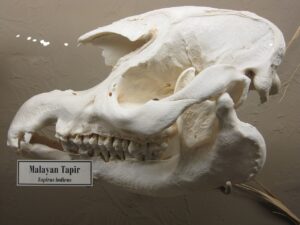
The Malayan tapir has a striking appearance, often described as a blend between a pig and an elephant. It has a large body and a long, prehensile proboscis used to grab food or even as a snorkel while swimming. The proboscis is correlated with the modifications of the skull entailing the enlarged sagittal crest, retracted narial incision (or nasoincisive incisure), rostrally positioned orbits, unusual skull shape, and elevated frontal bones, allows for the attachment of muscles needed for the tapir’s long, flexible snout [3].
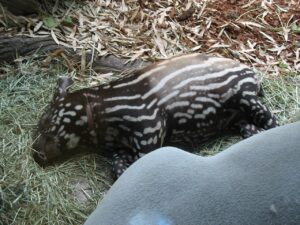
Its distinct black-and-white coloration — black head, shoulders, and legs, with a white rump, back, and belly — provides effective camouflage in the dappled light of the forest. Infants are born with a unique blackish-brown coat covered in white stripes and spots, offering them extra camouflage in the undergrowth.
Other names: lợn vòi/heo vòi/con mạch (Vietnam), cipan/tenuk/badak tampung (Malay)
GEOGRAPHIC DISTRIBUTION AND HABITAT
Malayan tapirs inhabit tropical rainforests and lower montane forests in Southeast Asia. Their current range includes Peninsular Malaysia, Sumatra (Indonesia), Thailand, and Myanmar [1,4].
Historically, Malayan tapirs were also recorded in Vietnam. According to Professor Đặng Huy Huỳnh, sightings occurred in the Southern and North Central regions [5]. However, these observations were extremely rare, and the species is now believed to be extinct in Vietnam. Sometimes, Vietnamese people refer them to “con mạch” [5].
DIET
Malayan tapirs are browsers, meaning they feed on vegetation found at mid to high levels in the forest. Their diet includes a wide range of plant matter such as leaves, twigs, bark, fruits, grasses, and aquatic plants. They are both frugivorous (fruit-eating) and folivorous (leaf-eating) [1].
LIFESTYLE
These animals are primarily solitary and nocturnal, being most active at night while resting during the day. Tapirs communicate through a range of vocalizations — including clicks, whistles, and hiccup-like sounds — used for mating, warning of danger, or interacting with other individuals [1].
REPRODUCTION AND FAMILY
Malayan tapirs typically follow a seasonal monogamous mating system, with breeding often occurring between May and June. After a gestation period of 11–13 months, females usually give birth to a single calf. Twin births are very rare. According to the IUCN Red List, the world’s first and only twin birth ever recorded was in Sg Dusun Tapir Conservation Centre, Malaysia [4]. The group name is candle or herd (e.g. A candle of tapirs).
ECOLOGICAL ROLE
As large herbivores, tapirs play a vital role in maintaining forest ecosystems. They help disperse seeds through their droppings, which contributes to plant regeneration. Additionally, as they move through dense forest undergrowth, their massive bodies create pathways that aid the growth of young saplings — earning them the title “gardener of the forest.”
CONSERVATION STATUS AND EFFORTS
The Malayan tapir is listed as Endangered (EN) on the IUCN Red List, with populations declining due to habitat loss, deforestation, land conversion, and hunting for meat and skin. They are also frequently caught in snares set for other animals [4].
In response, Malayan tapirs are legally protected in many national parks across Thailand, Myanmar, Peninsular Malaysia, and Sumatra. However, continued conservation efforts are urgently needed to ensure their survival.
REFERENCES
1. Animalia.bio. (n.d.). Malayan tapir. https://animalia.bio/malayan-tapir?environment=79
2. Thai National Parks. (n.d.). Malayan tapir (Tapirus indicus). Retrieved April 25, 2025, from https://www.thainationalparks.com/species/malayan-tapir
3. Witmer, L. M., Sampson, S. D., & Solounias, N. (1999). The proboscis of tapirs (Mammalia: Perissodactyla): A case study in novel narial anatomy. Journal of Zoology, 249(3), 249–267. https://doi.org/10.1111/j.1469-7998.1999.tb00763.x
4. Traeholt, C., Novarino, W., bin Saaban, S., Shwe, N.M., Lynam, A., Zainuddin, Z., Simpson, B. & bin Mohd, S. 2016. Tapirus indicus. The IUCN Red List of Threatened Species 2016: e.T21472A45173636. https://dx.doi.org/10.2305/IUCN.UK.2016-1.RLTS.T21472A45173636.en. Accessed on 25 April 2025.
5. Huynh, D. H. (1986). Biology and ecology of ungulates in Vietnam. Science and Technics Publishing House.
PICTURE CREDITS
1. A Malayan tapir by Rufus46 – Own work, CC BY-SA 3.0, https://commons.wikimedia.org/w/index.php?curid=35966715
2. A Malayan tapir skull on display at the Museum of Osteology by JimJones1971 at English Wikipedia, CC BY-SA 3.0, https://commons.wikimedia.org/w/index.php?curid=31634788
3. A juvenile Malayan tapir by Sasha Kopf – Own work, CC BY-SA 3.0, https://commons.wikimedia.org/w/index.php?curid=2621897
4. A Malayan tapir in Taman Negara National Park By Bernard DUPONT from FRANCE – Malayan Tapir (Tapirus indicus), CC BY-SA 2.0, https://commons.wikimedia.org/w/index.php?curid=40783751
LE QUANG