


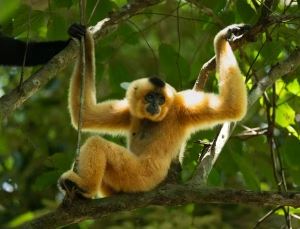
The southern yellow-cheeked gibbon (Nomascus gabriellae) is a small ape of the family Hylobatidae (the gibbons, or “small apes”), endemic to Indochina. It is found today in southern Vietnam and southeastern Cambodia, and historically in parts of southern Laos [1,2,5]. The species was first described in 1909 and named after the British naturalist Gabrielle Maud Vassal [6]. Like all gibbons, it is renowned for its acrobatic, arm-swinging locomotion and for the loud, far-carrying duet songs that mated pairs perform at dawn [1].
Other names
English: Southern yellow-cheeked crested gibbon, red-cheeked gibbon, buff-cheeked / buffy-cheeked gibbon, golden-cheeked gibbon [2,6].
Vietnamese: Vượn đen má vàng (Nam), vượn má vàng (Nam), vượn đen má hung (Nam) [9,12].
APPEARANCE
Although gibbons resemble monkeys, they are in fact apes and, like the great apes, have no tail. Compared with their great-ape relatives, gibbons are remarkably small-bodied, an adaptation to a life spent almost entirely in the forest canopy [1].
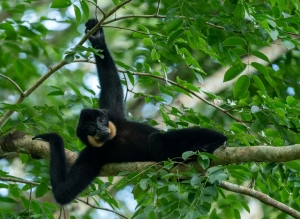
The southern yellow-cheeked gibbon shows one of the most striking colour changes in the primate world, varying with both age and sex. All infants are born a buffy-yellow colour. At around six months of age their coats darken to black. Males keep this black coat for the rest of their lives, while females change back to a yellow or buff pelage as they mature [1,11]. Adult males display the species’ signature yellow cheek patches, while some individuals appear orange or even reddish, and the chest may take on a subtle rusty-red tinge; a crest of erect hair sits on the crown. Adult females are yellow to yellow-reddish brown and often retain a dark brown or black patch of hair on the crown (Fig. 2) [1,3].
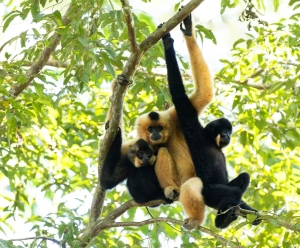
There is very little difference in body size between the sexes. Adults weigh roughly 5–12 kg; males measure about 45–50 cm in head-and-body length and females about 46–48 cm [1,5]. Gibbons are the true virtuosos of brachiation, and their bodies are built for it: ball-and-socket wrist joints, shoulder joints that rotate a full 360 degrees, very long arms, hook-shaped hands and reduced thumbs all combine to let them swing through the canopy with exceptional speed and control [1]. Crested gibbons are notoriously hard to tell apart in the wild, and the males’ cheek patches are usually the most reliable distinguishing feature [1].
GEOGRAPHIC DISTRIBUTION AND HABITAT
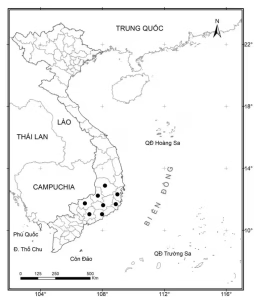
The southern yellow-cheeked gibbon is endemic to Indochina. Following the 2010 split, its confirmed range is smaller than once believed, covering southern Vietnam and southeastern Cambodia (east of the Mekong River) [1,2]. In Vietnam the distribution runs from around the Ba River (about 13°N, in Gia Lai and Phu Yen provinces) south to Nui Ong Nature Reserve (about 11°N, in Binh Thuan province) [2].
These arboreal apes prefer tall evergreen and semi-evergreen forest, but are also found in mixed deciduous and bamboo forest, generally at elevations up to about 1,500–2,000 m [1,3,5]. In Vietnam the species is recorded in several protected areas, including Cat Tien (Nam Cat Tien) National Park, Chu Yang Sin National Park and Bu Gia Map National Park, and across provinces such as Gia Lai, Kon Tum, Lam Dong, Khanh Hoa and Dong Nai [10,11,12, 13].
No single confirmed total exists for the species. The largest known population is thought to be in Cambodia’s Seima Protected Forest, where a Wildlife Conservation Society report estimated around 2,500 individuals — believed to be the world’s largest population of the species [9]. In Vietnam, an auditory mark-recapture survey of Chu Yang Sin National Park detected 28 gibbon groups [7].
DIET
The southern yellow-cheeked gibbon is highly frugivorous, with a strong preference for fruit and especially figs. Field study of feeding behaviour found that figs alone accounted for about 39% of feeding time, with other fruits making up about 43%, followed by leaves (38.4%), flowers (11.6%), and other vegetation parts (0.6%) [1,3,4]. Because fruit is not available year-round, the diet shifts seasonally: when fruit is scarce, the gibbons turn to mature and young leaves, flowers, other plant parts, vines and epiphytes, as well as some animal matter such as insects and bird eggs [1,5]. Families generally eat more fruit in the wet season than in the dry season [1].
LIFESTYLE
Southern yellow-cheeked gibbons are diurnal and almost exclusively arboreal, living high in the canopy and rarely descending to the forest floor [1]. They move chiefly by brachiation — swinging hand-over-hand beneath branches — and are remarkably fast and agile, reportedly reaching speeds of up to about 56 km/h (35 mph); they also walk upright along branches more than any other wild ape [1].
The species is territorial and notably an early riser. Around sunrise, mated pairs perform duet “songs” that can be heard for up to about a kilometre. These haunting calls help the pair relocate each other after sleeping apart, reinforce their bond, and warn neighbouring gibbons to keep their distance [1]. The female’s contribution is a series of rising notes that climaxes in a rapid “great call,” while the male produces his own distinct phrases; young males only begin giving the male call as subadults [1]. Beyond song, gibbons communicate through facial expressions, body language and mutual grooming, which helps strengthen family bonds [1].
REPRODUCTION AND FAMILY
Southern yellow-cheeked gibbons live in small, socially monogamous nuclear families, typically a mated pair together with up to about four offspring [1]. Pair bonds usually last for life but can occasionally break down; while pairs are socially monogamous, they may not be strictly sexually exclusive [1]. (As an exception to the usual pattern, a group with multiple breeding females has been documented in eastern Cambodia [8].)
After mating, the female is pregnant for around seven months and usually gives birth to a single infant, which is beige and clings closely to its mother, blending into her pale fur [1]. Both parents invest heavily in raising the young, and mothers space their births so that an older offspring is reasonably independent before the next is born. Offspring reach sexual maturity at about seven to eight years of age, around the time they leave their natal group to seek a mate of their own [1]. Although the wild lifespan is poorly documented, gibbons can live upwards of 30 years in the wild and up to roughly 50 years in captivity [1,5].
ECOLOGICAL ROLE
As frugivores, southern yellow-cheeked gibbons are important seed dispersers. Seeds from the fruit they eat pass through their digestive systems intact and are deposited, often far from the parent tree, in their droppings. This continual “planting” helps regenerate the forest and maintain the plant diversity [1].
CONSERVATION STATUS AND EFFORTS
The International Union for Conservation of Nature (IUCN) classifies the southern yellow-cheeked gibbon as Endangered, and its populations are in decline [1,2]. The species is listed in Appendix I of CITES, meaning international commercial trade is essentially prohibited [1,3]. In Vietnam it is listed as Endangered in the Vietnam Red Data Book and is strictly protected as a Group IB species under national law (formerly Decree 32/2006/ND-CP, and currently listed in Group IB under Circular 27/2025) [3,12]; it is also legally protected in Cambodia [1].
The greatest threats are habitat loss and fragmentation. Because the gibbons rely on continuous canopy to move, even a single narrow road can create a gap they cannot cross, forcing risky leaps or dangerous descents to the ground; fragmentation also isolates groups, increases conflict and reduces genetic diversity [1]. The species is also hunted for meat and traditional medicine, and — most damagingly — for the pet trade: poachers target infants and almost always kill the mother (and often the father) to capture one [1,11]. Captive gibbons are further used to entertain tourists and are widely shared on social media, which normalises keeping primates as pets [1]. Taxonomic uncertainty and inconsistent enforcement of existing protections add to the difficulty of conserving the species [1].
Several initiatives are working to protect it. The Dao Tien Endangered Primate Species Centre, established at Cat Tien National Park in 2008, rescues and rehabilitates the species (alongside other local primates) and runs education and gibbon-watching tours for locals and visitors [1]. The Endangered Primate Rescue Center at Cuc Phuong National Park rehabilitates confiscated and poached gibbons and educates the public, even though it lies outside the species’ natural range [1,3]. More recently, a women-led conservation team supported by the Wildlife Conservation Action (WildAct) “Empowering Women in Conservation” programme began monitoring the population in Chu Yang Sin National Park through dawn call surveys in late 2024 [10]. The IUCN highlights the need for more intensive patrolling, stricter gun laws, consistent enforcement, and continued rescue, rehabilitation and release [1].
REFERENCES
- New England Primate Conservancy. (n.d.). Southern Yellow-Cheeked Crested Gibbon, Nomascus gabriellae. Written by Z. Lussier, 2020, revised 2023. https://neprimateconservancy.org/southern-yellow-cheeked-crested-gibbon/
- Rawson, B.M., Hoang, M.D., Roos, C., Van, N.T. & Nguyen, M.H. 2020. Nomascus gabriellae. The IUCN Red List of Threatened Species 2020: e.T128073282A17968950. https://www.iucnredlist.org/species/128073282/17968950
- Endangered Primate Rescue Center. (n.d.). Southern Yellow-Cheeked Gibbon – Nomascus gabriellae. https://www.eprc.asia/southern-yellow-cheeked-gibbon/
- Bach, T.H., Chen, J., Hoang, M.D., Beng, K.C. & Nguyen, V.T. (2017). Feeding behavior and activity budget of the southern yellow-cheeked crested gibbons (Nomascus gabriellae) in a lowland tropical forest. American Journal of Primatology, 79: e22667.
- Quist, E. (n.d.). Nomascus gabriellae (red-cheeked gibbon). Animal Diversity Web, University of Michigan. https://animaldiversity.org/accounts/Nomascus_gabriellae/
- Yellow-cheeked gibbon. Wikipedia. https://en.wikipedia.org/wiki/Yellow-cheeked_gibbon
- Vu, T.T., Tran, D.V., Giang, T.T., et al. (2016). A mark-recapture population size estimation of southern yellow-cheeked crested gibbon Nomascus gabriellae in Chu Yang Sin National Park, Vietnam. Asian Primates Journal, 6: 33–42.
- Barca, B., Vincent, C., Soeung, K., Nuttall, M. & Hobson, K. (2016). Multi-female group in the southernmost species of Nomascus: field observations in Eastern Cambodia… Asian Primates Journal, 6: 15–19.
- Vượn đen má vàng Nam. Wikipedia tiếng Việt. https://vi.wikipedia.org/wiki/V%C6%B0%E1%BB%A3n_%C4%91en_m%C3%A1_v%C3%A0ng_Nam
- Thanh Niên. (2025, 26 April). “Nữ đặc nhiệm” bảo tồn vượn đen má vàng giữa rừng sâu Chư Yang Sin. https://thanhnien.vn/nu-dac-nhiem-bao-ton-vuon-den-ma-vang-giua-rung-sau-chu-yang-sin-185250424013802939.htm
- WANEE Vietnam. (2022). Nam Cát Tiên – Nơi cư trú loài Vượn đen má vàng quý hiếm tại Việt Nam. https://wanee.vn/nam-cat-tien-noi-cu-tru-loai-vuon-den-ma-vang/
- Báo Pháp Luật TP.HCM. (2025). TP.HCM: Vượn má vàng quý hiếm… (nhóm IB, Thông tư 27/2025). https://plo.vn/tphcm-vuon-ma-vang-quy-hiem-song-sot-o-khu-dan-cu-nho-nguoi-dan-cho-an-post869263.html
- Nguyễn Đình Duy, Trịnh Đình Hoàng, Nguyễn Vĩnh Thanh, Hà Thăng Long, 2023. Nomascus gabriellae. Danh lục Đỏ Việt Nam. MM24