


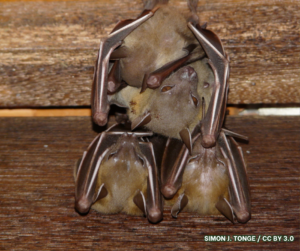
Lesser short-nosed fruit bat (Cynopterus brachyotis) is a fruit bat species belonging to he Pteropodidae family (fruit bats), within the order Chiroptera (bats).
Other names:
- Common short-nosed fruit bat
- Lesser dog-faced fruit bat
- Dơi chó tai ngắn (Vietnamese)
- ค้างคาวขอบหูขาวเล็ก (Thai) [1]
- හීන් තල වවුලා (Sinhala) [1]
Group name: cloud, colony, flock
APPEARANCE
Lesser short-nosed fruit bats are brown to yellowish brown and they have brighter collars, with adult males’ being dark orange while that of the female counterparts are yellowish. The bats also possess lower incisors, larger eyes, and a fox-resembling face. They have white ear edges and wing bones. The length of the forearm is 55-56 mm, the length of the tail is 8-10 mm, and the ear length is 14-16 mm [2].
GEOGRAPHIC DISTRIBUTION AND HABITAT
There are a total of nine subspecies of the lesser short-nosed fruit bat that are widely distributed in South Asia and Southeast Asia. In Vietnam, they are found as far north as Lao Cai, Hoa Binh, Hai Duong, Ha Noi, Ninh Binh to the central provinces like Quang Tri, Thua Thien-Hue, Quang Nam, Khanh Hoa, Kon Tum, Dak Lak, Lam Dong, Ninh Thuan to southwards Dong Nai, Ho Chi Minh City, Tay Ninh, Kien Giang. The subspecies found in Vietnam is Cynopterus brachyotis hoffeti [1][3]. Other concurrence includes Cambodia, China, India (Goa, Bihar, Tamil Nadu, Nagaland, Andhra Pradesh, Karnataka, Maharashtra), Indonesia (Sumatera, Sulawesi), Lao People’s Democratic Republic, Malaysia, Myanmar, Singapore, Sri Lanka, Thailand, and Timor-Leste [3].
Lesser short-nosed fruit bats prefer forests such as lower montane forests, tropical rainforests, gardens, mangroves, and urban.
DIET
As the name suggests, lesser short-nosed fruit bats are frugivores, so they consume aromatic fruits such as mangoes. Also, they are recorded feeding on nectar and pollen.
BEHAVIOR AND LIFESTYLE
Lesser short-faced bats are nocturnal and tend to roost in small groups in trees, under leaves, and in caves. A male can roost with around four females, whereas young males roost alone. Females may gather in groups of 20 individuals. The animal utilizes their incredible sense of smell and navigate with their vision in order to forage at night.
Reproduction and Family: This bat species typically mates from around December to January of the following year. Each year, it gives birth to one or two offspring in March-April and July-August. They follow the mating habit called polygyny, a mating system in which one male lives and mates with multiple females yet each female only mates with a single male. The pregnancy duration is about 3.5-4 months. Males play an active role in lactation and feeding the young as they have mammary glands with the same size as those of females [1]. The pup becomes weaned after 40-45 days [4][5].
Males become sexually mature after a year and females reach sexual maturation at approximately 6 to 8 months of age. The life span is about 30 years [2].
Ecological role
Since lesser short-nosed bats enjoy eating fruits, they are important zoochory species as they disperse seeds of different fruits like bananas, mangoes, dates, avocados, peaches, and so on. However, they are sometimes considered as crop pests when damaging fruits [1].
CONSERVATION STATUS
Currently, lesser short-nosed fruit bats are classified as “Least Concern” by IUCN due to their omnipresence across South Asia and Southeast Asia. However, this bat species are relatively rare in Vietnam because of different threats like habitat loss, deforestation, land conversion to agricultural purposes, and hunting for medical purposes. The species was listed in Vietnam’s Red List and their population in this country is in a downward trend [4].
CONSERVATION EFFORTS
Lesser short-faced fruit bats are currently protected in national parks. Several conservation works are done to protect this animal involving propaganda, reports and condemnation of illegal hunting or logging activities, and studies on biodiversity conservation in accordance with sustainable ecotourism [4][5][6].
REFERENCES
- Lesser short-nosed fruit bat. Thai National Parks.
- Lesser Short-Nosed Fruit Bat. Animalia.
- Csorba, G., Bumrungsri, S., Bates, P., Gumal, M., Kingston, T., Molur, S. & Srinivasulu, C. 2019. Cynopterus brachyotis. The IUCN Red List of Threatened Species 2019: e.T6103A22113381. https://dx.doi.org/10.2305/IUCN.UK.2019-3.RLTS.T6103A22113381.en. Accessed on 16 April 2025.
- Cynopterus brachyotis. Viet Nam Red List of Threatened Species.
- Dơi chó tai ngắn. Wildlife At Risk.
- Cần bảo tồn loài cò nhạn và dơi chó tai ngắn ở Sông Đầm. Quang Nam E-news.