


The Indochinese silver langur (Trachypithecus germaini), also called Germain’s langur, the Indochinese lutung, or the Indochinese leaf monkey, is an Old World monkey of the leaf-eating subfamily Colobinae (family Cercopithecidae) [4][5]. It is one of the silvered langurs of mainland Southeast Asia, ranging across Thailand, Myanmar, Cambodia, Laos and Vietnam [4][7][9].
Other names: Germain’s langur, Germain’s silver langur, Indochinese silvered langur, Indochinese lutung, Indochinese leaf monkey (English); Voọc bạc Đông Dương, Voọc bạc (Vietnamese).
APPEARANCE
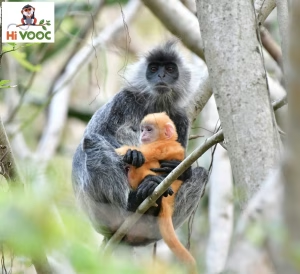
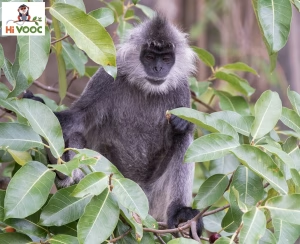
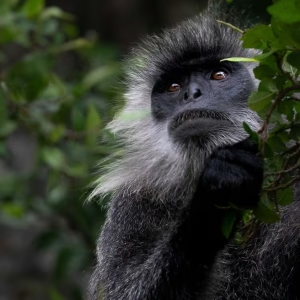
The adult Indochinese silver langur is cloaked in a thick, dark silvery-grey coat [4][9]. The face is dark and bare, ringed by a halo of long hair and topped with a silver-grey crest, while the belly, legs and underside of the tail are a paler silver than the body [4]. The hands and feet are dark, and — unlike some close relatives — the species lacks pale eye-rings [4]. Like other leaf monkeys it has long, hook-like fingers and a much-reduced thumb, an adaptation that lets it grip branches securely while swinging through the canopy with little energy [4].
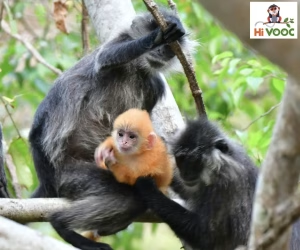
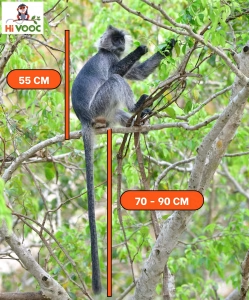
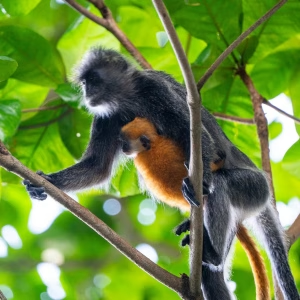
The species’ most striking feature is its infants: newborns are covered in brilliant golden-orange fur that stands out vividly against the silvery adults, and are born with pale faces, hands and feet that darken within days [4]. Over the following months the orange coat gradually silvers, and by about twelve months the young resemble the adults [5]. The most widely favoured explanation for this vivid natal colour is that it helps adults in the group keep track of the infants in dense forest [4]. Adults have a head-and-body length of roughly 55 cm and a tail of about 78 cm, and weigh on average 6.5–7 kg, with females slightly smaller than males [4]. In the field, observers also distinguish the sexes by the fur on the limbs, which tends to be longer and denser in males than in females.
GEOGRAPHIC DISTRIBUTION AND HABITAT
The Indochinese silver langur occurs across mainland Southeast Asia west of the Mekong — Thailand, Myanmar, Cambodia, southern Laos and southern Vietnam [4][6]. It is a lowland monkey, favouring evergreen and semi-evergreen forest, riparian and gallery forest, deciduous forest and limestone (karst) forest from sea level up to about 600 m, and is rarely found in hilly country at higher elevations [4][8].
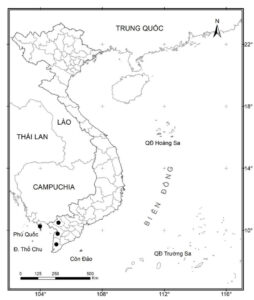
In Vietnam the species is now confined to the far south of the Mekong Delta region. Field surveys across three provinces confirmed it in semi-evergreen forest at the Seven Mountains (Bảy Núi) of An Giang; in mangrove forest in Ngoc Hien and Nam Can and Melaleuca forest in U Minh Ha National Park of Ca Mau; and in limestone forest in the Kien Luong Karst Area together with the semi-evergreen and evergreen forests of Phu Quoc National Park in Kien Giang [1][9]. The Vietnamese population is small and fragmented — conservatively estimated at 362–406 individuals — with the largest concentration, about 286 animals, in the Kien Luong Karst Area [1]. Encouragingly, numbers in Phu Quoc National Park and the Kien Luong karst have been increasing, even as the langur has disappeared from Mui Ca Mau National Park and survives only in tiny, isolated groups in the Seven Mountains and the Ca Mau mangroves [1]. One accessible spot to observe them is the Chua Hang karst area in Kien Luong, Kien Giang [2].
DIET
Indochinese silver langurs are highly folivorous, and in Vietnam’s karst forests their diet has been studied in detail [8][2]. A two-year study on Chua Hang Karst Mountain found that feeding took up about 45% of their daily activity, and that the diet was dominated by young leaves (roughly 58%), followed by fruit (about 23%), mature leaves (around 9–10%), and smaller amounts of flowers, buds and leaf stalks [2]. Across the study the langurs fed on parts of at least 53 plant species from 23 families, returning again and again to favourites such as figs and Phyllanthus reticulatus [8][4]. They are selective feeders, preferring leaves that are lower in tough fibre and bitter compounds and higher in natural sugars, and have even been recorded eating mushrooms and occasionally soil to supplement minerals and offset plant toxins [4]. Like all colobines, they carry an enlarged, multi-chambered, ruminant-like stomach whose bacteria ferment and break down cellulose — which is why they spend so much of the day resting to digest [7][4].
LIFESTYLE
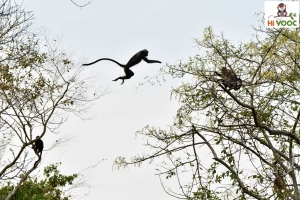
The Indochinese silver langur is arboreal and diurnal, spending most of its time in the trees, though it readily uses the forest understory and comes down to the ground to forage [4]. Its days are largely calm: studies put resting at around 47% of the activity budget and feeding at about 44%, with only small shares given to travel (roughly 5%) and grooming (about 4%) — a pattern typical of leaf-eaters, whose fibrous diet demands long rest periods for rumination [4]. Feeding tends to peak in the cooler early morning and late afternoon, while the hot midday hours are spent resting in the shade [4].
These langurs live in multi-male, multi-female groups that range from about seven to more than fifty individuals, often splitting into smaller subgroups through the day in a fission-fusion pattern [4]. They are also relatively quiet, relying on close social bonds and mutual grooming more than on loud calls, though they do give a sharp “khek khek” call in contexts such as alarm or keeping the group together [4].
REPRODUCTION AND FAMILY
Indochinese silver langurs reach sexual maturity at about three to four years of age [4]. After a gestation of roughly 196 days a female gives birth to a single infant; breeding is not strictly seasonal, but most of the bright orange newborns appear between November and May [4]. Infants cling to their mothers for the first months of life and grow more independent as their orange coat silvers over [4]. As in many langurs, females are thought to remain in their birth group for life while males disperse around maturity, and a male taking over a group may commit infanticide, which returns females to breeding condition sooner — a behaviour documented in several closely related langurs [4].
ECOLOGICAL ROLE
As dedicated leaf-eaters, Indochinese silver langurs help shape their forests. By browsing the leaves of the many tree species in their diet they effectively “prune” vegetation and influence which plants flourish in the understory and canopy [4]. When they feed on fruit they also act as occasional seed dispersers, aiding forest regeneration and plant diversity [4].
CONSERVATION STATUS AND EFFORTS
The IUCN Red List classifies the Indochinese silver langur as Endangered, reflecting a population decline of more than 50% over the past three generations [3][5]. The main threats are hunting — for bushmeat, the pet trade and traditional “medicine” — together with habitat loss and fragmentation from deforestation, agricultural conversion (including rubber plantations), dam construction, and, in Vietnam, limestone quarrying that has destroyed much of the habitat of the largest karst subpopulation in Kien Giang [4][3]. Because so many surviving groups are small and isolated, these pressures are all the more severe [4].
The species is listed on Appendix I of CITES, and in Vietnam it is legally protected at the highest level — under Decree 64/2019/NĐ-CP and Decree 84/2021/NĐ-CP of the Vietnamese government [3][8][9]. It occurs in a number of protected areas across its range, including Phu Quoc National Park and the Kien Luong Karst Area in Vietnam — where populations have shown signs of recovery — and Keo Seima Wildlife Sanctuary in Cambodia [1][4]. Stronger habitat protection, enforcement of hunting bans and community education are widely regarded as essential to reversing the decline; in Vietnam, the increases recorded at Phu Quoc and Kien Luong show that sustained protection can work [1][4].
REFERENCES
[1] Van Tran, B., Nguyen, M.A., Nguyen, D.Q., Truong, Q.B.T., Ang, A., Covert, H.H. & Hoang, D.M. (2017). Current conservation status of Germain’s langur (Trachypithecus germaini) in Vietnam. Primates 58(3): 435–440. https://doi.org/10.1007/s10329-017-0610-2
[2] Diet of the Indochinese silvered langur (Trachypithecus germaini) at Chua Hang Karst Mountain, Kien Luong District, Kien Giang Province, Vietnam (two-year study, 2014–2016). American Journal of Primatology. https://doi.org/10.1002/ajp.23041
[3] IUCN Red List of Threatened Species: Trachypithecus germaini (Endangered). https://www.iucnredlist.org/species/39874/217754957
[4] New England Primate Conservancy. (2025). Indochinese Silvered Langur, Trachypithecus germaini. https://neprimateconservancy.org/indochinese-silvered-langur/
[5] Germain’s langur. Wikipedia. https://en.wikipedia.org/wiki/Germain%27s_langur
[6] A Summary of the Conservation Status, Taxonomic Assignment and Distribution of the Indochinese Silvered Langur, Trachypithecus germaini (sensu lato), in Cambodia. Asian Primates Journal 2(1): 21–28. https://www.researchgate.net/publication/233921998
[7] First reference genome assembly of the Indochinese silvered langur (Trachypithecus germaini). Zoological Research / PMC. https://pmc.ncbi.nlm.nih.gov/articles/PMC9336458/
[8] Indochinese Silvered Langur (Trachypithecus germaini) — species account (CITES status, Vietnamese legal protection, diet composition, altitude range). Zoological Park Organization of Thailand. https://www.zoothailand.org/en/animal_view.php?detail_id=188
[9] Nguyễn Đình Duy, Trịnh Đình Hoàng, Nguyễn Vĩnh Thanh, Hà Thăng Long, 2023. Trachypithecus germaini. Danh lục Đỏ Việt Nam. MM18