


The Delacour’s langur (Trachypithecus delacouri) is a large, critically endangered monkey of the Old World monkey family (Cercopithecidae), found nowhere else on Earth but the limestone karst forests of northern Vietnam [1,2]. It was named after the French-American ornithologist , who is honoured in its scientific name [5]. In Vietnamese it is best known as “voọc mông trắng” (white-rumped langur) or “voọc quần đùi trắng” (white-trousered langur) — a nickname inspired by the crisp band of creamy-white fur wrapping the hips and thighs like a pair of fitted white shorts [2,6]. Once treated as a subspecies of François’ langur (Trachypithecus francoisi), it was recognised as a full species in 1984, a decision later supported by molecular genetic studies around 2001 [2]. The species is also the emblem of Cuc Phuong National Park, Vietnam’s oldest national park [12].
The Delacour’s langur is classified as Critically Endangered (CR) on the IUCN Red List — the highest level of extinction risk before “Extinct in the Wild.” Its population has fallen by more than 80% over the past three generations (about 36 years), driven mainly by hunting for traditional “medicine” and by the loss and fragmentation of its karst habitat [1]. Fewer than 250 mature individuals are thought to survive, making it one of the world’s most endangered primates [1].
Other names
English: White-rumped black langur, Delacour’s lutung [2,5].
Vietnamese: Voọc mông trắng, voọc quần đùi trắng [2,6].
APPEARANCE
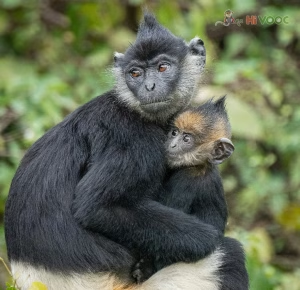
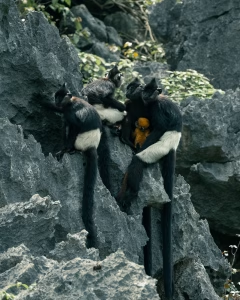
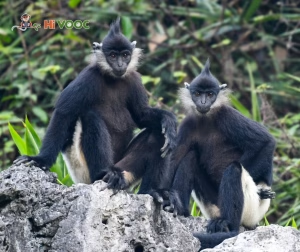
The Delacour’s langur is instantly recognisable among Southeast Asian langurs for its bold black-and-white coloration and long, bushy tail [3]. The body is predominantly glossy black, with a sharply defined band of creamy-white fur running from just above the hips to just above the knees — the marking that gives the animal its “white shorts” outlook and its Vietnamese name [2,3]. Long white whiskers frame the cheeks (longer than in related Indochinese black langurs), and a patch of white hair extends from behind the ears down the neck [3]. Like other members of the genus Trachypithecus, it carries a crest of tall, upright hair over the crown; in this species the crest is noticeably taller and narrower than in its relatives [4]. The long black tail is not prehensile and cannot grasp objects [2].
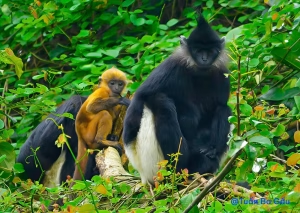
Infants are born with bright orange fur and pale, yellowish facial skin. The orange coat begins to darken at around four months of age and is gradually replaced by the adult black pattern, with the full coat and “shorts” complete by about three years old [2]. This vivid natal coloration is thought to encourage alloparenting, a care form of the young by group members other than the mother [2].
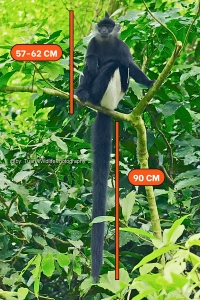
The species shows modest sexual dimorphism. Males are slightly larger, weighing about 7.5–10.5 kg, while females weigh about 6.2–9.2 kg [2,4]. Head-and-body length is roughly 57–62 cm in both sexes, with a tail of about 82–90 cm [4,5]. Females carry a distinctive pale “pubic patch” of white fur and pale skin in front of the sitting pads (ischial callosities), which is the main visual cue for telling the sexes apart [2,3]. Average life expectancy in the wild is around 20 years [2].
GEOGRAPHIC DISTRIBUTION AND HABITAT
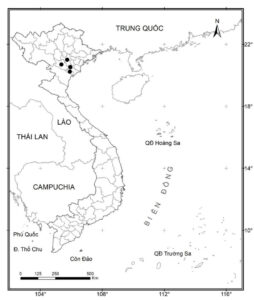
The Delacour’s langur is endemic to northern Vietnam, where it is restricted to a fragmented range of roughly 5,000 km² [1]. Its scattered subpopulations are closely tied to the belts of limestone karst mountains in the provinces of Ninh Binh, Ha Nam, Hoa Binh, and Thanh Hoa; a population was also confirmed in the Huong Son special-use forest (My Duc, Hanoi) [2,3,13]. The species occurs in five protected areas: Cuc Phuong National Park, Pu Luong Nature Reserve, Hoa Lu Cultural-Historical Site, Huong Son Cultural-Historical Site, and Van Long Nature Reserve [2,13].
The langurs live in broadleaf evergreen and shrubby forest growing on steep limestone karst [2]. They are generally found at low elevations within the karst, up to a few hundred metres above sea level (recorded to about 330 m at Van Long) [4,5]. Caves and rock faces are central to the animal’s daily life, providing sleeping sites and shelter from cold and predators [2].
DIET
The Delacour’s langur is primarily folivorous — a leaf specialist — although it also takes shoots, fruit, flowers, and bark [3]. Leaves make up roughly 60–80% of the diet, with a preference for tender young leaves over tougher mature ones [2,3]. Like other leaf-eating colobines, the species has a specialised, multi-chambered (ruminant-like) stomach and broad, sharp-cusped molars that allow it to break down and ferment cellulose-rich foliage; because this digestion is slow and energy-intensive, the langurs rest for long periods between feeding bouts [2]. They forage both in the trees and on the ground among the rocks [2].
LIFESTYLE
Delacour’s langurs are diurnal, active by day and resting at night on open rock ledges or inside limestone caves [2,5]. Unusually for a langur, they are strongly adapted to life on the cliffs: they spend much of their time moving across steep limestone rock as well as through trees, aided by specialised pads on the hands, feet, and rump that grip the razor-sharp karst, and they use their long tails for balance on the rugged terrain [2,5]. Individual groups tend to return to the same caves across generations [2].
Groups usually number around ten animals — typically one adult male, several females, and their offspring — but range from about 4 to 16 individuals; in the past, when the species was more numerous, troops of up to 30 were recorded [2,3]. Small all-male “bachelor” groups have also been observed [2,4]. Social bonds are maintained through grooming and play, while males defend the group’s territory, keeping watch from rocky outcrops and confronting intruders [2,4].
Communication combines vocalisations and visual displays. To warn of danger, group members give fast, short snorts as alarm calls; in territorial encounters the langurs use hoots, guttural snorts, and barks, and may shake or tear down branches to create loud crashing sounds that intimidate rivals [2].
REPRODUCTION AND FAMILY
After a gestation of roughly 180–200 days, a female gives birth to a single infant, with subsequent births separated by intervals of about 19–25 months [2]. Newborns are relatively well developed (precocial) — born with their eyes open and able to cling to their mother from birth [2]. Infant care is shared: all the females in a group help raise the young, a behaviour known as allomothering or alloparenting, and the infants’ bright orange coats make them easy for carers to locate [2]. Females reach sexual maturity at about four years of age and males at about five [2].
ECOLOGICAL ROLE
As a leaf-eating primate that also consumes fruit, the Delacour’s langur contributes to its ecosystem as a seed disperser, spreading undigested seeds through its droppings and helping forest plants regenerate [2]. Through selective feeding it also acts as a natural “pruner,” which can encourage healthy plant growth — an especially valuable role in the fragile, heavily disturbed limestone karst habitats where it lives [2].
CONSERVATION STATUS AND EFFORTS
The IUCN lists the Delacour’s langur as Critically Endangered, and it is likewise ranked Critically Endangered in the Vietnam Red Data Book (Sách Đỏ Việt Nam) [1,8]. It is protected under Vietnamese law as a Group IB species — the strictest protection category — under Decree 06/2019/ND-CP as amended by Decree 84/2021/ND-CP, and as a species prioritised for protection under the framework of Decree 160/2013/ND-CP (amended by Decree 64/2019/ND-CP) [8]. Internationally it is listed in Appendix II of CITES, which regulates trade to prevent over-exploitation [1,2].
The main threat is hunting — primarily to supply traditional “medicine,” but also for food and the pet trade; on top of this, deforestation, agricultural encroachment, and above all limestone quarrying for cement have destroyed and fragmented much of the karst habitat [1,2]. Fragmentation isolates the small subpopulations, raising the risk of inbreeding and reducing the species’ long-term viability [2].
There have, however, been notable successes. Van Long Nature Reserve in Ninh Binh — established in 2001 specifically to protect this langur — holds the largest surviving population; under community-led protection, including patrol teams that recruited former hunters, the reserve’s langurs have roughly quadrupled from around 50–70 animals to an estimated 150–200 [6,9,10]. In 2020 Van Long became the first protected area in Vietnam admitted to the IUCN Green List of Protected and Conserved Areas [9]. The second-largest population survives in the Kim Bang limestone forest (Ha Nam), where conservationists and Fauna & Flora have long urged the government to formally establish a dedicated Species and Habitat Conservation Area [6,7].
The Endangered Primate Rescue Center (EPRC) in Cuc Phuong National Park — founded in 1993 by German primatologist Tilo Nadler with the Frankfurt Zoological Society — has been central to research, rescue, captive breeding, and the ongoing protection of the Van Long population [3,10]. Captive-bred langurs have been used in reintroduction efforts, and a semi-wild group released onto Ngoc Island in the Trang An landscape complex produced its first wild-born infant in 2021 [11].
REFERENCES
- Nadler, T., Quyet, L.K., Rawson, B.M. & Coudrat, C.N.Z. 2020. Trachypithecus delacouri. The IUCN Red List of Threatened Species 2020: e.T22043A17958988.
- New England Primate Conservancy. Delacour’s Langur, Trachypithecus delacouri.
- Endangered Primate Rescue Center. Delacour’s Langur – Trachypithecus delacouri.
- Harding, L.E. 2010. Trachypithecus delacouri (Primates: Cercopithecidae). Mammalian Species 42(880): 1–15.
- Wikipedia. Delacour’s langur.
- Fauna & Flora. Delacour’s langur (Monkeys of Vietnam).
- Nguyen, A.T., Le, M.D. et al. 2021. Status of a second viable population of the Critically Endangered Delacour’s langur in Viet Nam. Oryx.
- Vietnam Red Data Book / Sách Đỏ Việt Nam and Government of Vietnam legal decrees (Decree 06/2019/ND-CP amended by 84/2021/ND-CP, Group IB; Decree 160/2013/ND-CP amended by 64/2019/ND-CP). Legal status summarised in Báo Tiền Phong (3 Aug 2025).
- Mongabay (25 Mar 2021). Thriving population of endangered monkeys gives hope to conservationists (Van Long; IUCN Green List).
- PANORAMA Solutions / IUCN. Conservation of Delacour’s Langur in Van Long Wetland Nature Reserve, Vietnam.
- Báo Ninh Bình (28 Oct 2021), first birth of a reintroduced langur at Ngoc Island, Trang An (https://baoninhbinh.org.vn/vooc-mong-trang-sinh-san-ca-the-dau-tien-tai-quan-the-danh/d202110281423539.htm); and VietnamPlus (2026) on the Van Long–Kim Bang–Tam Chuc UNESCO nomination (https://www.vietnamplus.vn/quan-the-vooc-mong-trang-di-san-thien-nhien-nguyen-so-giua-co-do-post1109766.vnp).
- Cuc Phuong National Park. Voọc mông trắng (species emblem of the park).
- Nguyễn Đình Duy, Trịnh Đình Hoàng, Nguyễn Vĩnh Thanh, Hà Thăng Long, 2023. Trachypithecus delacouri. Danh lục Đỏ Việt Nam. MM16